How Did Michelangelo Use Geometric Patterns Iin His Art
New study unveils Michelangelo's extensive use of the gilded ratio in the Sistine Chapel.
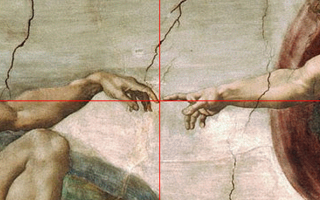 In 2013, I reported that Michelangelo used the aureate ratio in his painting "The Cosmos of Adam" in the Sistine Chapel. This Divine Proportion appears at the point at which Adam's finger is touched past the finger of God, equally God breathes life into Adam.
In July 2015, Clinical Beefcake published an article by a team from Brazil titled "More than than a neuroanatomical representation in The Creation of Adam by Michelangelo Buonarroti, a representation of the Golden Ratio." (PDF here.) The article claimed, incorrectly, that at that place was no previous association of Michelangelo's works with the golden ratio. It identified the very aforementioned golden ratio touch on bespeak as the i reported here two years before.
It as well claimed, still, a new finding. It claimed that the fingers touched at the golden ratio bespeak of the length of all the paintings on the ceiling of the Sistine Chapel. My analysis of this merits revealed it to be inaccurate. (Come across separate commodity Discovery of the Golden Ratio in Michelangelo's "The Creation of Adam.") It motivated though me to take a much deeper expect at Michelangelo's limerick of his paintings in the Sistine Chapel. This led to much richer evidence even so of his use of the golden ratio.
Over two dozen uses of the aureate ratio appear in the Sistine Chapel.
This expanded analysis led to the discovery of more than 2 dozen examples of the golden ratio. This provides compelling evidence that this "Divine proportion" was an essential guide in the composition of this work. The analysis was performed using PhiMatrix design and analysis software to notice gilt ratios, or whatever custom ratio, with pixel-level accurateness.
Perhaps the most stunning instance, as shown in my 2013 article, is the betoken at which the fingers of God and Adam touch in "The Cosmos of Adam. This is found at the gilt ratio of both their horizontal and vertical dimensions. Click on the image for full resolution:
-

- The Creation of Adam by Michelangelo
The same golden ratio point appears if yous instead use the inside or outside borders of the painting, rather than the borders of God and Adam. Click on images for higher resolution.
Should it exist suggested that this impact bespeak does not actually correspond the golden ratio, see the analogy below. The green line shows the departure created past using a ratio of 1.6 instead of 1.618.
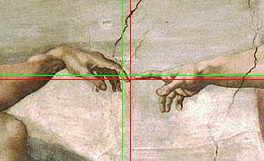
This evidence of its utilise is rather conclusive in itself, and yet information technology's but a subtle hint to the rest of the story that unfolds.
The fingers and hands likewise touch on at Golden Ratio points in other paintings
Michelangelo repeated this theme of the characters touching the golden ratio indicate in other paintings of the Sistine Chapel, equally illustrated in the five paintings below. The dark-green lines show the gilded ratio of the summit and/or width of each painting.
The last of the series of nine biblical narration paintings on the center ceiling is of Noah's disgrace. In information technology, the fingers of two of Noah's sons point directly to the golden ratio points from the painting's sides. It's washed as if to show the viewer exactly where they are, and the fact that Michelangelo had indeed applied the Divine proportion. Subsequently all, this incredible drove of paintings was created for the Vatican, the seat of Peter and successor Popes of the Roman Catholic Church. If he wanted to give testify to his use of the Divine proportion, he would take wanted it to be clear and undeniable. He may have done and then with a bit of wit:
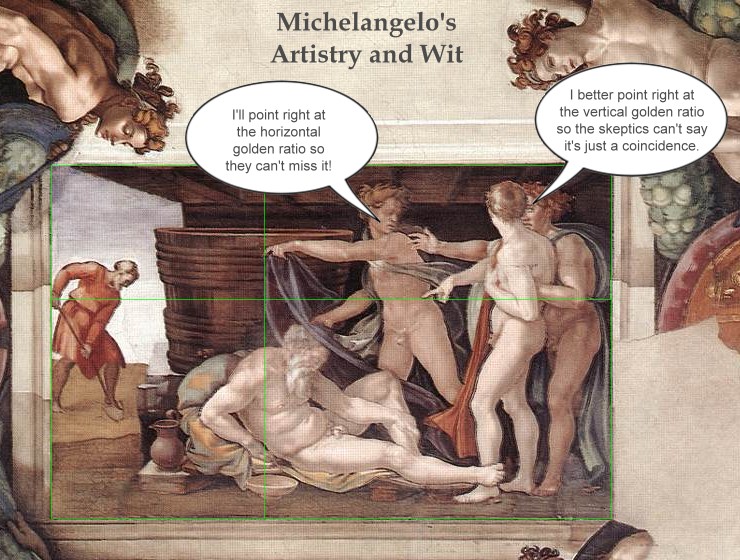
In this and other paintings, the hands are positioned as though grasping this golden proportion. It can be viewed equally a visual metaphor of human being want to grasp the Divine. Click on any epitome for full resolution.
Golden Ratios in the positions of the subjects within the paintings
Farther analysis of the paintings reveals other likely applications of the aureate ratio in their composition. The images below illustrate that Michelangelo appears to have used the golden ratio in the positioning of the main characters within each painting. Click on whatever paradigm for full resolution.
Admittedly, the more you look at the detailed elements of any painting, the more chance you have of finding some gilded ratios. These examples, nevertheless, use the primary elements of the composition. The best evidence is the many obvious examples of its utilize based solely on the height and width of the paintings. These demonstrate that Michelangelo's employ of the Divine proportion was quite deliberate and intentional.
Gilded Ratios in the proportions of the paintings to the frames
Each of the paintings on the center section of the ceiling is framed by 2 larger ceiling sections that split the paintings. For seven of the ix paintings, the width of the painting is a golden ratio of a gold ratio. This but means that you lot take the golden ratio of a dimension (reddish grid) and then in turn take the golden ratio of that dimension (blue grid), equally illustrated below:

The dark-green lines in the three big images below illustrate the awarding of this concept. The ruby-red arrows evidence the second golden ratio signal in relation to the width of the framed area. Click on any image for full resolution.
The prototype below shows how this pattern of gold ratios of golden ratios was repeated for the paintings and framing sections across the ceiling. Click on the image for full resolution.
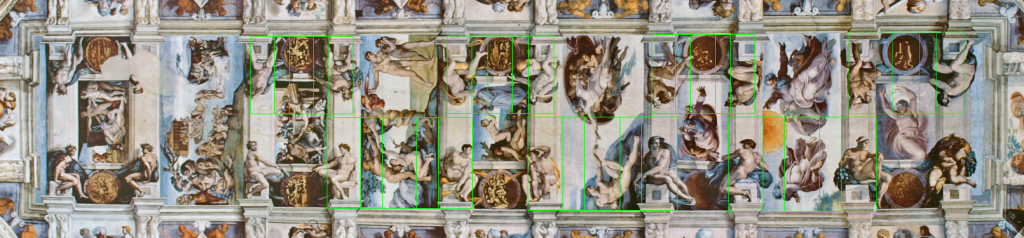
Note the alternating pattern:
- A large painting, whose dimensions are based on the outside border of the separating section.
- A small painting, whose dimensions are based on the inside edge of the separating section.
The final two paintings of the biblical narrative, on the left side in this paradigm, are close to these same golden ratios only practice not use it so precisely equally the others.
Gold Rectangles in the Ceiling Paintings
In addition to the in a higher place evidence, the dimensions of two of the five small paintings inset on the ceiling judge Golden Rectangles with an accuracy of 1/100th. This is shown by the green rectangles:
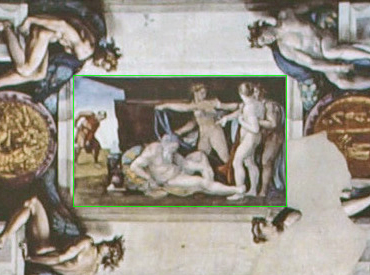
"The Drunkenness of Noah" – Aspect Ratio of ane.half-dozen
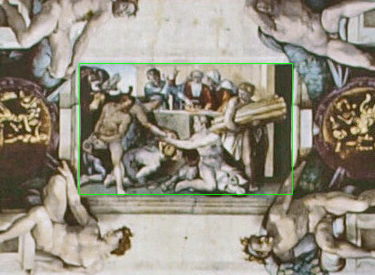
The Cede of Noah – Aspect Ratio of 1.6
Also, the positions of the numerous human figures sitting along the opposite sides of the ceiling are based on the golden ratio of the width of the center section of the ceiling.
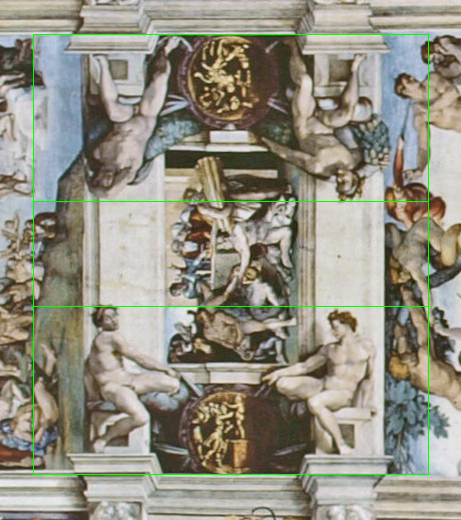
The tablets of the ancestors of Jesus are Gilt Rectangles
If in that location remains any doubt that Michelangelo used the Divine Proportion, expect to the paintings of the tablets list the ancestors of Jesus on the side walls of the Chapel. The top to width of the proper noun plates class a gold rectangle, as shown in green in the images below. Nearly of the proper noun plates are within a pixel or two of being golden rectangles. The boilerplate peak to width ratio of of all the paintings is ane.62, accurate to inside 1/1000th of the golden ratio of ane.618. Click on whatever image for full resolution.
Michelangelo was in concert with other Renaissance greats of Luca Pacioli, Leonardo da Vinci and others
Michelangelo painted the Sistine Chapel betwixt 1508 and 1512. The volume "The Divine Proportion" (De Divina Proportione), written past Luca Pacioli and illustrated past Leonardo da Vinci, was composed between 1496 and 1498, and beginning printed in 1509. Cognition of the golden ratio conspicuously existed earlier Pacioli began to write the book. There's bear witness of this in the earlier paintings of Leonardo, Botticelli, Raphael and other Renaissance painters. Leonardo da Vinci used this Divine proportion in a number of his paintings, including The Annunciation in about 1473, The Final Supper in 1495 and Salvator Mundi effectually 1500.
Luca Pacioli, author of "De Divina Proportione," begins the volume with this introduction:
"A work necessary for all the clear-sighted and inquiring human minds, in which everyone who loves to written report philosophy, perspective, painting, sculpture, architecture, music and other mathematical disciplines will discover a very delicate, subtle and admirable education and volition delight in diverse questions touching on a very underground science."
Dr. Mario Livio, author of The Gilt Ratio: The Story of Phi, the World's Almost Astonishing Number, describes "De Divina Proportion" (on pages 132-133) every bit follows:
"Pacioli raves ceaselessly about the properties of the Golden Ratio"
"at that place is no doubt that Pacioli had a great interest in the arts and that his intention in The Divine Proportion was partly to perfect their mathematical ground."
"His opening statement on the book's kickoff folio expresses his desire to reveal to artists, through the Aureate Ratio, the "secret" of harmonic forms."
Kenneth Clark, author of "Culture" observed:
"This union of art and mathematics is far from our own manner of thinking, but information technology was fundamental to the Renaissance."
The gilt ratio, known then equally the Divine proportion, was a highly regarded tool for artistic composition and expression in the Renaissance art. Information technology was used past the masters of the Renaissance to bring both mathematical and visual harmony to the elements inside a piece of work of art. It was thought to embody an essence of the Divine. Consider these quotes of Michelangelo's contemporaries:
"Without mathematics in that location is no art." Luca Pacioli, author of "De Divina Proportione"
"Where the spirit does not work with the hand there is no art." Leonardo da Vinci
Michelangelo's painting of the Vatican's Sistine Chapel had incredible religious significance. Information technology really should be no surprise that Michelangelo would have used the Divine proportion extensively in the creation of this work. In hindsight, it would be much more of a surprise if he had not.
References:
http://www.scielo.br/scielo.php?script=sci_arttext&pid=S1677-55382012000300004
https://en.wikipedia.org/wiki/Michelangelo
https://en.wikipedia.org/wiki/Sistine_Chapel_ceiling
https://en.wikipedia.org/wiki/Gallery_of_Sistine_Chapel_ceiling
https://en.wikipedia.org/wiki/The_Creation_of_Adam
Design and Analysis past PhiMatrix software
levinewearecomell.blogspot.com
Source: https://www.goldennumber.net/michelangelo-sistine-chapel-golden-ratio-art-design/
0 Response to "How Did Michelangelo Use Geometric Patterns Iin His Art"
Postar um comentário