Modern Technologies and Arts in the Late Twentieth Century
| Holocene | ||||||
|---|---|---|---|---|---|---|
| Chronology | ||||||
| ||||||
| Etymology | ||||||
| Name formality | Formal | |||||
| Usage data | ||||||
| Celestial body | World | |||||
| Regional usage | Global (ICS) | |||||
| Time scale(s) used | ICS Time Calibration | |||||
| Definition | ||||||
| Chronological unit | Epoch | |||||
| Stratigraphic unit | Serial | |||||
| Time span formality | Formal | |||||
| Lower boundary definition | End of the Younger Dryas stadial. | |||||
| Lower boundary GSSP | NGRIP2 water ice core, Greenland 75°06′00″N 42°19′12″W / 75.1000°Due north 42.3200°Due west / 75.1000; -42.3200 | |||||
| GSSP ratified | 2008 (every bit base of Holocene)[1] | |||||
| Upper purlieus definition | Present day | |||||
| Upper purlieus GSSP | N/A N/A | |||||
| GSSP ratified | N/A | |||||
The Holocene ( HOL-ə-seen, HOL-oh-, HOH-lə-, HOH-loh-)[2] [iii] is the current geological epoch. It began approximately 11,650 cal years before present (c. 9700 BCE), later on the last glacial period, which concluded with the Holocene glacial retreat.[4] The Holocene and the preceding Pleistocene[five] together form the Quaternary menses. The Holocene has been identified with the current warm period, known as MIS one. Information technology is considered past some to exist an interglacial period within the Pleistocene Epoch, called the Flandrian interglacial.[vi]
The Holocene corresponds with the rapid proliferation, growth and impacts of the man species worldwide, including all of its written history, technological revolutions, development of major civilizations, and overall pregnant transition towards urban living in the present. The human being touch on mod-era Earth and its ecosystems may be considered of global significance for the future evolution of living species, including approximately synchronous lithospheric evidence, or more recently hydrospheric and atmospheric evidence of the human impact. In July 2018, the International Spousal relationship of Geological Sciences split the Holocene Epoch into 3 distinct subsections based on the climate, Greenlandian (eleven,700 years ago to 8,200 years ago), Northgrippian (8,200 years ago to 4,200 years agone) and Meghalayan (four,200 years ago to the present), as proposed by International Commission on Stratigraphy.[7] The oldest subsection, the Greendlandian was characterized by a warming following the preceding water ice age. The Northgrippian stage is known for vast cooling due to a disruption in sea circulations that was acquired by the melting of glaciers. The most recent subsection of the Holocene is the present Meghalayan, which began with extreme drought that lasted around 200 years. [seven]
Etymology [edit]
The word is formed from two Aboriginal Greek words. Holos ( ὅλος ) is the Greek word for "whole". "Cene" comes from the Greek word kainos ( καινός ), meaning "new". The concept is that this epoch is "entirely new".[8] [9] [ten] The suffix '-cene' is used for all the vii epochs of the Cenozoic Era.
Overview [edit]
It is accustomed by the International Commission on Stratigraphy that the Holocene started approximately 11,650 cal years BP.[4] The Subcommission on Quaternary Stratigraphy (SQS) observes the terms 'contempo' to be an wrong way of referring to the Holocene, and the term 'modern' may exist used instead to describe current processes. It likewise observes the term 'Flandrian' may be used as a synonym for Holocene, although it is becoming outdated.[11] The International Committee on Stratigraphy, however, considers the Holocene an epoch following the Pleistocene and specifically the final glacial period. Local names for the last glacial catamenia include the Wisconsinan in North America,[12] the Weichselian in Europe,[13] the Devensian in Uk,[fourteen] the Llanquihue in Republic of chile[15] and the Otiran in New Zealand.[16]
The Holocene can be subdivided into five time intervals, or chronozones, based on climatic fluctuations:[17]
- Preboreal (10 ka–ix ka BP),
- Boreal (nine ka–8 ka BP),
- Atlantic (eight ka–5 ka BP),
- Subboreal (5 ka–2.five ka BP) and
- Subatlantic (2.5 ka BP–present).
- Note: "ka BP" means "kilo-annum Before Present", i.e. ane,000 years earlier 1950 (non-calibrated C14 dates)
Geologists working in different regions are studying sea levels, peat bogs and water ice core samples by a variety of methods, with a view toward farther verifying and refining the Blytt–Sernander sequence. This is a nomenclature of climatic periods initially defined past plant remains in peat mosses.[18] Though the method was once thought to be of little interest, based on 14C dating of peats that was inconsistent with the claimed chronozones,[nineteen] investigators take found a full general correspondence across Eurasia and North America. The scheme was defined for Northern Europe, but the climate changes were claimed to occur more widely. The periods of the scheme include a few of the final pre-Holocene oscillations of the last glacial menstruation and so allocate climates of more than recent prehistory.[twenty]
Paleontologists have non defined any faunal stages for the Holocene. If subdivision is necessary, periods of human technological development, such as the Mesolithic, Neolithic, and Bronze Age, are usually used. However, the time periods referenced by these terms vary with the emergence of those technologies in different parts of the globe.[21]
According to some scholars, a tertiary partitioning, the Anthropocene, has at present begun.[22] This term is used to denote the present time interval in which many geologically significant conditions and processes have been profoundly altered by human activities. The 'Anthropocene' (a term coined past Paul J. Crutzen and Eugene Stoermer in 2000) is not a formally defined geological unit of measurement. The Subcommission on Quaternary Stratigraphy of the International Commission on Stratigraphy has a working group to determine whether information technology should be. In May 2019, members of the working group voted in favour of recognizing the Anthropocene as formal chrono-stratigraphic unit, with stratigraphic signals around the mid-twentieth century CE as its base. The exact criteria have still to be decided upon, afterward which the recommendation also has to be canonical by the working group's parent bodies (ultimately the International Marriage of Geological Sciences).[23]
Geology [edit]
The Holocene is a geologic epoch that follows direct subsequently the Pleistocene. Continental motions due to plate tectonics are less than a kilometre over a span of merely 10,000 years. However, ice melt caused globe sea levels to rising about 35 m (115 ft) in the early on part of the Holocene and another 30 m in the afterward part of the Holocene. In improver, many areas above well-nigh 40 degrees north breadth had been depressed by the weight of the Pleistocene glaciers and rose every bit much as 180 thou (590 ft) due to post-glacial rebound over the belatedly Pleistocene and Holocene, and are still rise today.[24]
The bounding main-level rising and temporary state depression allowed temporary marine incursions into areas that are now far from the sea. For example, marine fossils from the Holocene epoch have been institute in locations such as Vermont and Michigan. Other than college-latitude temporary marine incursions associated with glacial depression, Holocene fossils are found primarily in lakebed, floodplain, and cave deposits. Holocene marine deposits along low-latitude coastlines are rare because the rising in ocean levels during the period exceeds whatever likely tectonic uplift of non-glacial origin.[ citation needed ]
Post-glacial rebound in the Scandinavia region resulted in a shrinking Baltic Sea. The region continues to rise, yet causing weak earthquakes across Northern Europe. An equivalent upshot in Due north America was the rebound of Hudson Bay, every bit it shrank from its larger, immediate post-glacial Tyrrell Sea phase, to its present boundaries.[25]
Climate [edit]
The climate throughout the Holocene has shown significant variability despite ice core records from Greenland suggesting a more stable climate following the preceding ice historic period. Marine chemical fluxes during the Holocene were lower than during the Younger Dryas, only were still considerable enough to imply notable changes in the climate. The Greenland ice core records indicate that climate changes became more regional and had a larger result on the mid-to-low latitudes and mid-to-high latitudes after ~5600 B.P.[26] During the transition from the last glacial to the Holocene, the Huelmo–Mascardi Cold Reversal in the Southern Hemisphere began earlier the Younger Dryas, and the maximum warmth flowed south to north from 11,000 to 7,000 years agone. It appears that this was influenced by the balance glacial ice remaining in the Northern Hemisphere until the later appointment.[ citation needed ]
The Holocene climatic optimum (HCO) was a menses of warming throughout the globe. It has been suggested that the warming was not uniform across the world. Ice core measurements imply that the sea surface temperature (SST) gradient east of New Zealand, across the subtropical front (STF), was effectually 2 degrees Celsius. This temperature gradient is significantly less than modern times, which is around 6 degrees Celsius. A study utilizing five SST proxies from 37°S to lx°S latitude confirmed that the strong temperature gradient was confined to the surface area immediately south of the STF, and is correlated with reduced westerly winds near New Zealand.[27] From the 10th-14th century, the climate was similar to that of modern times during a period known as the Medieval climate optimum, or the Medieval warm flow (MWP). Information technology was plant that the warming that is taking place in current years is both more than frequent and more than spatially homogeneous than what was experienced during the MWP. A warming of +ane caste Celsius occurs 5-xl times more frequently in modern years than during the MWP. The major forcing during the MWP was due to greater solar activity, which led to heterogeneity compared to the greenhouse gas forcing of modern years that leads to more than homogeneous warming. This was followed by the Little Water ice Age, from the 13th or 14th century to the mid-19th century.[28]
The temporal and spatial extent of climate change during the Holocene is an area of considerable uncertainty, with radiative forcing recently proposed to be the origin of cycles identified in the North Atlantic region. Climate cyclicity through the Holocene (Bond events) has been observed in or near marine settings and is strongly controlled by glacial input to the North Atlantic.[29] [30] Periodicities of ≈2500, ≈1500, and ≈m years are by and large observed in the Due north Atlantic.[31] [32] [33] At the same time spectral analyses of the continental tape, which is remote from oceanic influence, reveal persistent periodicities of 1,000 and 500 years that may stand for to solar activity variations during the Holocene Epoch.[34] A i,500-year bike corresponding to the North Atlantic oceanic apportionment may accept had widespread global distribution in the Belatedly Holocene.[34]
Ecological developments [edit]
Beast and constitute life accept non evolved much during the relatively short Holocene, but at that place have been major shifts in the richness and abundance of plants and animals. A number of large animals including mammoths and mastodons, saber-toothed cats like Smilodon and Homotherium, and giant sloths went extinct in the late Pleistocene and early Holocene. The extinction of some megafauna in America could be attributed to the Clovis people; this culture was known for "Clovis points" which were fashioned on spears for hunting animals. Shrubs, herbs, and mosses had as well changed in relative abundance from the Pleistocene to Holocene, identified by permafrost cadre samples.[35]
Throughout the world, ecosystems in cooler climates that were previously regional have been isolated in college altitude ecological "islands".[36]
The 8.two-ka event, an abrupt cold spell recorded every bit a negative excursion in the δ xviiiO record lasting 400 years, is the virtually prominent climatic result occurring in the Holocene Epoch, and may have marked a resurgence of ice cover. It has been suggested that this result was caused by the terminal drainage of Lake Agassiz, which had been confined by the glaciers, disrupting the thermohaline circulation of the Atlantic.[37] This disruption was the upshot of an ice dam over Hudson bay collapsing sending common cold lake Agassiz water into the Northward Atlantic Sea.[38] Furthermore, studies show that the melting of Lake Agassiz led to sea-level ascension which flooded the North American coastal landscape. The basal peat plant was and then used to determine the resulting local body of water-level rise of 0.xx-0.56m in the Mississippi delta. [38]Subsequent enquiry, however, suggested that the discharge was probably superimposed upon a longer episode of cooler climate lasting up to 600 years and observed that the extent of the area affected was unclear.[39]
Human being developments [edit]
The beginning of the Holocene corresponds with the beginning of the Mesolithic age in almost of Europe. In regions such as the Middle East and Anatolia, the term Epipaleolithic is preferred in place of Mesolithic, as they refer to approximately the aforementioned fourth dimension menses. Cultures in this flow include Hamburgian, Federmesser, and the Natufian civilisation, during which the oldest inhabited places still existing on Globe were first settled, such as Tell es-Sultan (Jericho) in the Middle East.[40] There is also evolving archeological evidence of proto-faith at locations such as Göbekli Tepe, as long ago every bit the 9th millennium BCE.[41]
The Late Holocene brought advancements such as the bow and arrow first found in Washington and Oregan, creating more efficient forms of hunting and replacing spear throwers. [42]However, the domestication of plants and animals allowed human civilization to develop villages and towns in centralized locations. Archaeological data shows that between 10,000 to 7,000 BP rapid domestication of plants and animals took place in tropical and subtropical parts of Asia, Africa, and Central America. [43]The development of farming immune human civilization to transition away from hunter and gatherer nomadic cultures, which did not establish permanent settlements, to a more than sustainable sedentary lifestyle. This form of lifestyle alter allowed human civilization to develop towns and villages in centralized locations, which gave rise to the earth known today. It is believed that the domestication of plants and animals began in the early role of the Holocene in the tropical areas of the planet. [43]Considering these areas had warm, moist temperatures, the climate was perfect for effective farming. Civilisation development and homo population change, specifically in South America, has likewise been linked to spikes in hydroclimate resulting in climate variability in the mid-Holocene (8.2 - 4.2 k cal BP).[44] Climate change on seasonality and available moisture also allowed for favorable agricultural conditions which promoted human development for Maya and Tiwanaku regions.[45]
Gallery [edit]
-
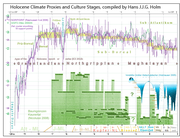
Combination of temperature indicators ("proxies") for north-western Europe from Greenland icecores and Tall glacier extensions, with subdivisions from 3 disciplines
-

-

Paleogeographic reconstruction of the N Sea approximately 9,000 years ago during the early Holocene and after the end of the Last Glacial Period
See besides [edit]
- 8.two-kiloyear event
- 10th millennium BCE
- Blytt–Sernander system
- Holocene agenda
- Holocene extinction
- Neolithic Subpluvial
- Older Peron
- Outburst overflowing
- Piora Oscillation
- Quaternary extinction event
References [edit]
- ^ Walker, Mike; Johnse, Sigfus; Rasmussen, Sune; Steffensen, Jørgen-Peder; Popp, Trevor; Gibbard, Phillip; Hoek, Wilm; Lowe, John; Andrews, John; Björck, Svante; Cwynar, Les; Hughen, Konrad; Kershaw, Peter; Kromer, Bernd; Litt, Thomas; Lowe, David; Nakagawa, Takeshi; Newnham, Rewi; Schwande, Jakob (June 2008). "The Global Stratotype Section and Indicate (GSSP) for the base of operations of the Holocene Series/Epoch (4th Arrangement/Period) in the NGRIP water ice cadre". Episodes. 32 (2): 264–267. doi:ten.18814/epiiugs/2008/v31i2/016.
- ^ "Holocene". Merriam-Webster Dictionary . Retrieved Feb 11, 2018.
- ^ "Holocene". Dictionary.com Unabridged (Online). n.d. Retrieved February eleven, 2018.
- ^ a b Walker, Mike; Johnsen, Sigfus; Rasmussen, Sune Olander; Popp, Trevor; Steffensen, Jorgen-Peder; Gibrard, Phil; Hoek, Wim; Lowe, John; Andrews, John; Bjo Rck, Svante; Cwynar, Les C.; Hughen, Konrad; Kersahw, Peter; Kromer, Bernd; Litt, Thomas; Lowe, David J.; Nakagawa, Takeshi; Newnham, Rewi; Schwander, Jakob (2009). "Formal definition and dating of the GSSP (Global Stratotype Section and Point) for the base of the Holocene using the Greenland NGRIP ice core, and selected auxiliary records" (PDF). Periodical of 4th Science. 24 (1): 3–17. Bibcode:2009JQS....24....3W. doi:x.1002/jqs.1227. Archived (PDF) from the original on 2013-eleven-04. Retrieved 2013-09-03 .
- ^ Fan, Junxuan; Hou, Xudong. "International Chronostratigraphic Nautical chart". International Commission on Stratigraphy. Archived from the original on January 13, 2017. Retrieved June xviii, 2016.
- ^ Oxford University Press – Why Geography Matters: More than Ever (volume) – "Holocene Humanity" section https://books.google.com/books?id=7P0_sWIcBNsC Archived 2019-12-31 at the Wayback Machine
- ^ a b Amos, Jonathan (2018-07-18). "Welcome to the Meghalayan Age a new phase in history". BBC News. Archived from the original on 2018-07-xviii. Retrieved 2018-07-eighteen .
- ^ The name "Holocene" was proposed in 1850 by the French palaeontologist and entomologist Paul Gervais (1816–1879): Gervais, Paul (1850). "Sur la répartition des mammifères fossiles entre les différents étages tertiaires qui concourent à former le sol de la French republic" [On the distribution of mammalian fossils amid the different tertiary stages which help to grade the ground of French republic]. Académie des Sciences et Lettres de Montpellier. Section des Sciences (in French). ane: 399–413. Archived from the original on 2020-05-22. Retrieved 2018-07-15 . From p. 413: Archived 2020-05-22 at the Wayback Machine "On pourrait aussi appeler Holocènes, ceux de l'époque historique, ou dont le dépôt n'est pas antérieur à la présence de l'homme ; … " (One could too call "Holocene" those [deposits] of the historic era, or the deposit of which is non prior to the presence of man ; … )
- ^ "Origin and significant of Holocene". Online Etymology Dictionary. Archived from the original on 2019-08-08. Retrieved 2019-08-08 .
- ^ "Origin and meaning of suffix -cene". Online Etymology Dictionary. Archived from the original on 2019-08-08. Retrieved 2019-08-08 .
- ^ Gibbard, P. L.; Head, M. J. (2020-01-01), Gradstein, Felix Grand.; Ogg, James Thousand.; Schmitz, Mark D.; Ogg, Gabi M. (eds.), "Chapter xxx - The Quaternary Catamenia", Geologic Time Scale 2020, Elsevier, pp. 1217–1255, ISBN978-0-12-824360-2 , retrieved 2022-04-21
- ^ Clayton, Lee; Moran, Stephen R. (1982). "Chronology of late wisconsinan glaciation in middle North America". Fourth Science Reviews. 1 (1): 55–82. Bibcode:1982QSRv....1...55C. doi:10.1016/0277-3791(82)90019-1.
- ^ Svendsen, John Inge; Astakhov, Valery I.; Bolshiyanov, Dimitri Yu.; Demidov, Igor; Dowdeswell, Julian A.; Gataullin, Valery; Hjort, Christian; Hubberten, Hans W.; Larsen, Eiliv; Mangerud, Jan; Melles, Martin; Moller, Per; Saarnisto, Matti; Siegert, Martin J. (March 1999). "Maximum extent of the Eurasian ice sheets in the Barents and Kara Sea region during the Weichselian" (PDF). Boreas. 28 (1): 234–242. doi:10.1111/j.1502-3885.1999.tb00217.x. Archived (PDF) from the original on 2018-02-12. Retrieved 2018-02-11 .
- ^ Eyles, Nicholas; McCabe, A. Marshall (1989). "The Late Devensian (<22,000 BP) Irish Ocean Basin: The sedimentary tape of a collapsed ice sheet margin". Quaternary Science Reviews. viii (four): 307–351. Bibcode:1989QSRv....8..307E. doi:x.1016/0277-3791(89)90034-6.
- ^ Denton, G.H.; Lowell, T.5.; Heusser, C.J.; Schluchter, C.; Andersern, B.One thousand.; Heusser, Linda Eastward.; Moreno, P.I.; Marchant, D.R. (1999). "Geomorphology, stratigraphy, and radiocarbon chronology of LlanquihueDrift in the expanse of the Southern Lake District, Seno Reloncavi, and Isla Grande de Chiloe, Chile" (PDF). Geografiska Annaler: Series A, Physical Geography. 81A (2): 167–229. doi:x.1111/j.0435-3676.1999.00057.x. S2CID 7626031. Archived from the original (PDF) on 2018-02-12.
- ^ Newnham, R.Thou.; Vandergoes, One thousand.J.; Hendy, C.H.; Lowe, D.J.; Preusser, F. (February 2007). "A terrestrial palynological tape for the last two glacial cycles from southwestern New Zealand". 4th Science Reviews. 26 (three–four): 517–535. Bibcode:2007QSRv...26..517N. doi:10.1016/j.quascirev.2006.05.005.
- ^ Mangerud, Jan; Anderson, Svend T.; Berglund, Bjorn E.; Donner, Joakim J. (October 1, 1974). "Quaternary stratigraphy of Norden: a proposal for terminology and classification" (PDF). Boreas. 3 (3): 109–128. doi:10.1111/j.1502-3885.1974.tb00669.x. Archived (PDF) from the original on Feb sixteen, 2020. Retrieved September 15, 2013.
- ^ Viau, André E.; Gajewski, Konrad; Fines, Philippe; Atkinson, David Eastward.; Sawada, Michael C. (1 May 2002). "Widespread testify of 1500 yr climate variability in North America during the past 14 000 year". Geology. 30 (five): 455–458. Bibcode:2002Geo....thirty..455V. doi:10.1130/0091-7613(2002)030<0455:WEOYCV>2.0.CO;2.
- ^ Blackford, J. (1993). "Peat bogs as sources of proxy climatic information: past approaches and future enquiry" (PDF). Climate change and human affect on the landscape. Dordrecht: Springer. pp. 47–56. doi:10.1007/978-94-010-9176-3_5. ISBN978-0-412-61860-four . Retrieved xx November 2020.
- ^ Schrøder, N.; Højlund Pedersen, L.; Juel Bitsch, R. (2004). "x,000 years of climate alter and human impact on the environment in the area surrounding Lejre". The Periodical of Transdisciplinary Ecology Studies. 3 (1): 1–27.
- ^ "Middle Ages | Definition, Dates, Characteristics, & Facts". Encyclopedia Britannica. Archived from the original on 2021-06-11. Retrieved 2021-06-04 .
- ^ Pearce, Fred (2007). With Speed and Violence . Beacon Printing. p. 21. ISBN978-0-8070-8576-nine.
- ^ "Working Group on the "Anthropocene"". Subcommission on Quaternary Stratigraphy. International Commission on Stratigraphy. January iv, 2016. Archived from the original on February 17, 2016. Retrieved June xviii, 2017.
- ^ Gray, Louise (October 7, 2009). "England is sinking while Scotland rises higher up body of water levels, according to new study". The Daily Telegraph. Archived from the original on 2022-01-11. Retrieved June 10, 2014.
- ^ Lajeuness, Patrick; Allard, Michael (2003). "The Nastapoka drift belt, eastern Hudson Bay: implications of a stillstand of the Quebec-Labrador ice margin in the Tyrrell Sea at 8 ka BP" (PDF). Canadian Journal of Earth Sciences. 40 (1): 65–76. Bibcode:2003CaJES..40...65L. doi:ten.1139/e02-085. Archived from the original (PDF) on 2004-03-22.
- ^ O'Brien, South. R.; Mayewski, P. A.; Meeker, 50. D.; Meese, D. A.; Twickler, M. S.; Whitlow, South. I. (1995-12-22). "Complexity of Holocene Climate as Reconstructed from a Greenland Ice Core". Science. 270 (5244): 1962–1964. doi:x.1126/science.270.5244.1962. ISSN 0036-8075.
- ^ Prebble, J. Chiliad.; Bostock, H. C.; Cortese, 1000.; Lorrey, A. M.; Hayward, B. W.; Calvo, E.; Northcote, L. C.; Scott, G. H.; Neil, H. L. (2017-08). "Evidence for a Holocene Climatic Optimum in the southwest Pacific: A multiproxy study: Holocene Optimum in SW Pacific". Paleoceanography. 32 (8): 763–779. doi:10.1002/2016PA003065.
- ^ Guiot, Joël (March, 2012). "A robust spatial reconstruction of April to September temperature in Europe: Comparisons between the medieval period and the recent warming with a focus on extreme values". Global and Planetary Change. 84–85: Pages 14–22 – via ScienceDirect.
- ^ Bond, G.; et al. (1997). "A Pervasive Millennial-Scale Cycle in North Atlantic Holocene and Glacial Climates" (PDF). Science. 278 (5341): 1257–1266. Bibcode:1997Sci...278.1257B. doi:10.1126/science.278.5341.1257. Archived from the original (PDF) on 2008-02-27.
- ^ Bond, G.; et al. (2001). "Persistent Solar Influence on Due north Atlantic Climate During the Holocene". Scientific discipline. 294 (5549): 2130–2136. Bibcode:2001Sci...294.2130B. doi:10.1126/science.1065680. PMID 11739949. S2CID 38179371. Archived from the original on 2022-03-21. Retrieved 2020-01-24 .
- ^ Bianchi, 1000.G.; McCave, I.N. (1999). "Holocene periodicity in North Atlantic climate and deep-sea flow south of Iceland". Nature. 397 (6719): 515–517. Bibcode:1999Natur.397..515B. doi:x.1038/17362. S2CID 4304638.
- ^ Viau, A.E.; Gajewski, K.; Sawada, Thou.C.; Fines, P. (2006). "Millennial-scale temperature variations in North America during the Holocene". Journal of Geophysical Research. 111 (D9): D09102. Bibcode:2006JGRD..111.9102V. doi:ten.1029/2005JD006031.
- ^ Debret, M.; Sebag, D.; Crosta, X.; Massei, N.; Petit, J.-R.; Chapron, E.; Tour-Roumazeilles, Five. (2009). "Testify from wavelet analysis for a mid-Holocene transition in global climate forcing" (PDF). Fourth Science Reviews. 28 (25): 2675–2688. Bibcode:2009QSRv...28.2675D. doi:x.1016/j.quascirev.2009.06.005. Archived (PDF) from the original on 2018-12-28. Retrieved 2018-12-sixteen .
- ^ a b Kravchinsky, 5.A.; Langereis, C.G.; Walker, S.D.; Dlusskiy, K.G.; White, D. (2013). "Discovery of Holocene millennial climate cycles in the Asian continental interior: Has the sun been governing the continental climate?". Global and Planetary Change. 110: 386–396. Bibcode:2013GPC...110..386K. doi:10.1016/j.gloplacha.2013.02.011.
- ^ Willerslev, Eske; Hansen, Anders J.; Binladen, Jonas; Make, Tina B.; Gilbert, M. Thomas P.; Shapiro, Beth; Bunce, Michael; Wiuf, Carsten; Gilichinsky, David A.; Cooper, Alan (2003-05-02). "Diverse Plant and Animal Genetic Records from Holocene and Pleistocene Sediments". Science. 300 (5620): 791–795. doi:10.1126/science.1084114. ISSN 0036-8075.
- ^ Singh, Ashbindu (2005). One Planet, Many People: Atlas of Our Changing Environment. United nations Environment Program. p. 4. ISBN978-9280725711. Archived from the original on 2020-01-02. Retrieved 2017-06-28 .
- ^ Hairdresser, D.C; Dyke, A.; Hillaire-Marcel, C.; Jennings, A.Eastward.; Andrews, J.T.; Kerwin, Yard.W.; Bilodeau, G.; McNeely, R.; Southon, J.; Morehead, K.D.; Gagnon, J.-M. (July 22, 1999). "Forcing of the cold event of viii,200 years agone by catastrophic drainage of Laurentide lakes". Nature. 400 (6742): 344–348. Bibcode:1999Natur.400..344B. doi:ten.1038/22504. S2CID 4426918.
- ^ a b Li, Yong-Xiang; Törnqvist, Torbjörn E.; Nevitt, Johanna G.; Kohl, Barry (2012-01-15). "Synchronizing a sea-level jump, final Lake Agassiz drainage, and abrupt cooling 8200years ago". World and Planetary Science Letters. Ocean Level and Ice Sheet Evolution: A PALSEA Special Edition. 315–316: 41–50. doi:x.1016/j.epsl.2011.05.034. ISSN 0012-821X.
- ^ Rohling, Eelco J.; Pälike, Heiko (April 21, 2005). "Centennial-calibration climate cooling with a sudden consequence around 8,200 years agone". Nature. 434 (7036): 975–979. Bibcode:2005Natur.434..975R. doi:x.1038/nature03421. PMID 15846336. S2CID 4394638.
- ^ Chisholm, Hugh, ed. (1911). . Encyclopædia Britannica (11th ed.). Cambridge University Press.
- ^ Back-scratch, Andrew (November 2008). "Göbekli Tepe: The World's Starting time Temple?". Smithsonian Magazine. Archived from the original on March 17, 2009. Retrieved March 14, 2009.
- ^ Snow, Dean R. (2010). Archaeology of Native North America. Upper Saddle River NJ: Prentice Hall. p. 384. ISBN978-0136156864. Archived from the original on 2022-03-nineteen. Retrieved 2019-08-xx .
- ^ a b Gupta, Anil K. (2004). "Origin of agriculture and domestication of plants and animals linked to early on Holocene climate amelioration". Electric current Science. 87 (one): 54–59. ISSN 0011-3891.
- ^ Riris, Philip; Approach-Kalin, Manuel (2019-05-09). "Widespread population decline in South America correlates with mid-Holocene climate alter". Scientific Reports. 9 (1): 6850. doi:10.1038/s41598-019-43086-w. ISSN 2045-2322. PMC6509208. PMID 31073131.
- ^ Brenner, Mark; Hodell, David A.; Rosenmeier, Michael F.; Curtis, Jason H.; Binford, Michael W.; Abbott, Mark B. (2001-01-01), Markgraf, Vera (ed.), "Chapter half-dozen - Abrupt Climate Alter and Pre-Columbian Cultural Collapse", Interhemispheric Climate Linkages, San Diego: Bookish Printing, pp. 87–103, doi:ten.1016/b978-012472670-iii/50009-4, ISBN978-0-12-472670-three , retrieved 2022-04-23
Farther reading [edit]
- Hunt, C.O.; Rabett, R.J. (2014). "Holocene landscape intervention and plant food production strategies in island and mainland Southeast Asia". Periodical of Archaeological Science. 51: 22–33. doi:x.1016/j.jas.2013.12.011.
- Mackay, A. West.; Battarbee, R.W.; Birks, H.J.B.; et al., eds. (2003). Global modify in the Holocene. London: Arnold. ISBN978-0-340-76223-3.
- Roberts, Neil (2014). The Holocene: an environmental history (3rd ed.). Malden, MA: Wiley-Blackwell. ISBN978-1-4051-5521-2.
External links [edit]
 | Look upwardly Holocene in Wiktionary, the free dictionary. |
 | Wikimedia Commons has media related to Holocene. |
- The Holocene epoch explained by the BBC
- ghK Classification
- History of Earth'due south Climate vii – Cenozoic Four – Holocene
levinewearecomell.blogspot.com
Source: https://en.wikipedia.org/wiki/Holocene
0 Response to "Modern Technologies and Arts in the Late Twentieth Century"
Postar um comentário