when referring to a woman what is a "white tiger" in chinese
According to the Chinese Zodiac calendar, 2022 marks the Year of the Tiger, the tertiary i of 12 zodiac animals based on the Heavenly Stems and Branches chart in Chinese traditional culture. The Tiger, known as rex of all beasts in China, has had a close relationship with the Chinese people since ancient times. The animal bears smashing symbolism - power and daring, and a subject of awe and fear, and is prized for its beauty and majesty, adored by Chinese people and featured heavily in Chinese culture.
Hither are merely some of the many cultural elements attributed to the tiger going back thousands of years.
Earliest 'tiger'
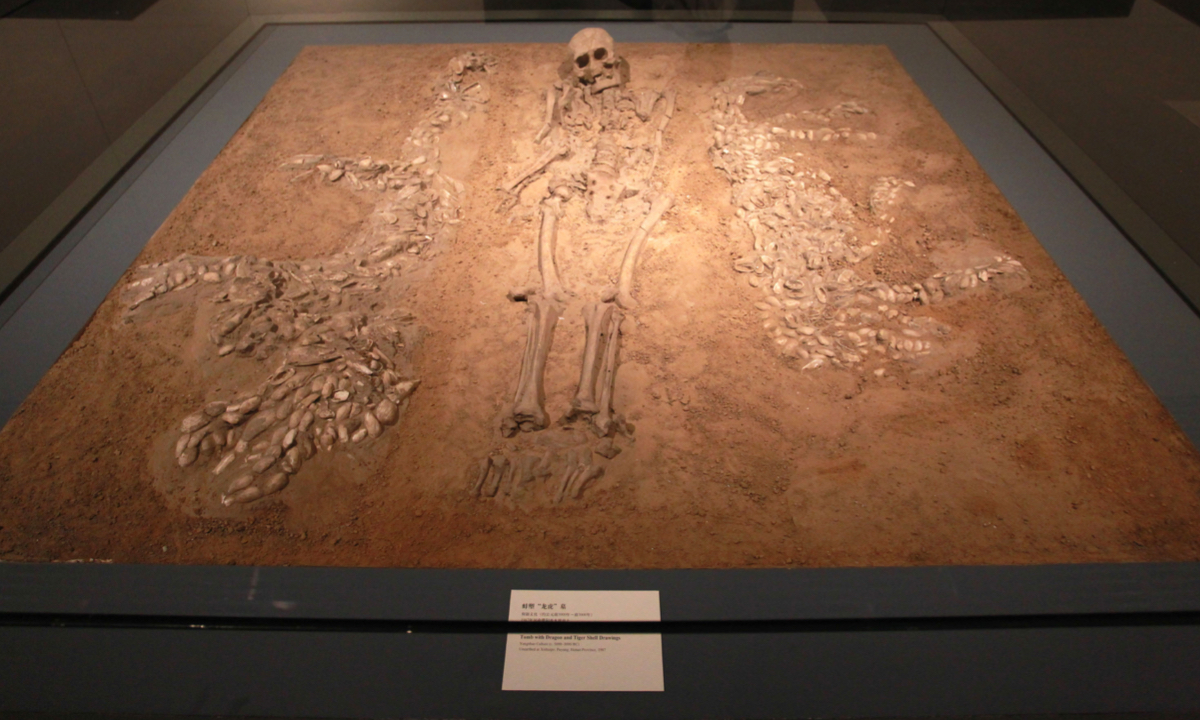
A beat "tiger" dating back to more than 6,000 years agone was found in a Neolithic Yangshao culture burial site in Puyang, Key China's Henan Province by Chinese archaeologists in 1987. Photo: VCG
A beat "tiger" dating back to more than 6,000 years ago was constitute in a Neolithic Yangshao culture burial site in Puyang, Cardinal Red china's Henan Province by Chinese archaeologists in 1987.
A person was buried between a dragon and tiger fabricated of white clam shells. On the left side of the remains was the tiger design. The tiger'southward caput faced north and its back faced due east. Information technology was 1.39 meters long and 0.63 meters high.
The earliest "tiger" opens its mouth and stares straight ahead, with a hung tail when walking and looks lifelike.
The tiger and dragon patterns bear witness that the 2 very important symbols in Chinese culture, which started from the Neolithic period.
The Yangshao civilisation was a Neolithic civilisation extensively along the Yellow River in People's republic of china.
The most mysterious tigers
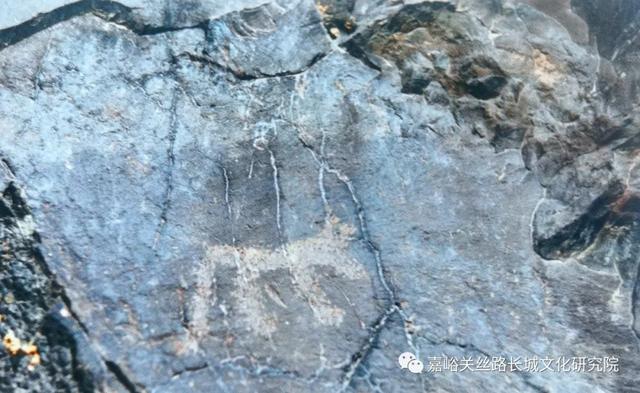
Helanshan rock carvingsin the Helan Mountains
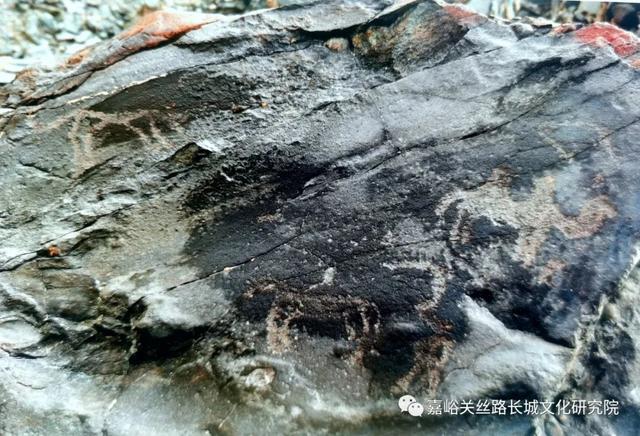
Rock carvings in the Helan Mountains
Tigers are ane of the master themes in the ancient rock art carvings found in China. They were seldom mentioned in the history of Northwest China'southward Qinghai Province, but were seen in rock art carvings from different ages. They were seen in carvings plant in Haibei Tibetan Democratic Prefecture, which dates dorsum to the Bronze Age. In a etching constitute in the Tibetan Democratic Prefecture believed to accept been carved in the Wei and Jin dynasties (Ad 220-420), a tiger is depicted devouring a yak, an animal unique to the Qinghai-Xizang(Tibet) Plateau. Scholars said information technology was depiction of real life, confirming their existence in Qinghai.
Tigers are also a main theme in the carvings plant in the Helan Mountains in Northwest Mainland china's Ningxia Hui Autonomous Region, and in Beishan in Yongchang county, Gansu Province. In carvings institute in these two places, at to the lowest degree 29 draw tigers. Some are lonely, some in pairs, and some an ambush; some are stalking while others are the casualty.
Scholars said these carvings could date back to earlier bronze tiger ornaments and bronze swords popularity.
In the Heishan rock art carvings in Jiayuguan, Gansu Province, iii are about tigers. Ane is 0.1 meters long and 0.09 meters tall. A tiger with a big head, slender body, and long legs heads north, its long tail trailing on the basis.
The other shows a tiger 0.twenty meters long and 0.15 meters high. The tiger, with a big caput and pointed ears, has its mouth open.
The tertiary slice, i meter long and 0.nine meters high, contains iv drawings: a tiger, a camel, a horse, and a whip wielder. The tiger takes upwards the upper left corner of the entire painting. Its mouth is open, its head lowered, and tail rolled, about to attack. It looks vivid, as if it is virtually to spring from the rock.
The fact that tigers are often seen in rock art carvings indicates that the Heishan area used to be an animal paradise with loftier mountains and thick forests, and abundant h2o and ample grass.
The 'tiger' with 'the most beautiful sound'
The "tiger" with the "most beautiful sound" is the Chunyu, an ancient, oblong percussion musical musical instrument whose elevation has a tiger-shaped handle. As a forbearer in aboriginal Mainland china, information technology was created in the Spring and Autumn Period (770BC-476BC), and was widely used in the Han Dynasty (206BC-AD220).
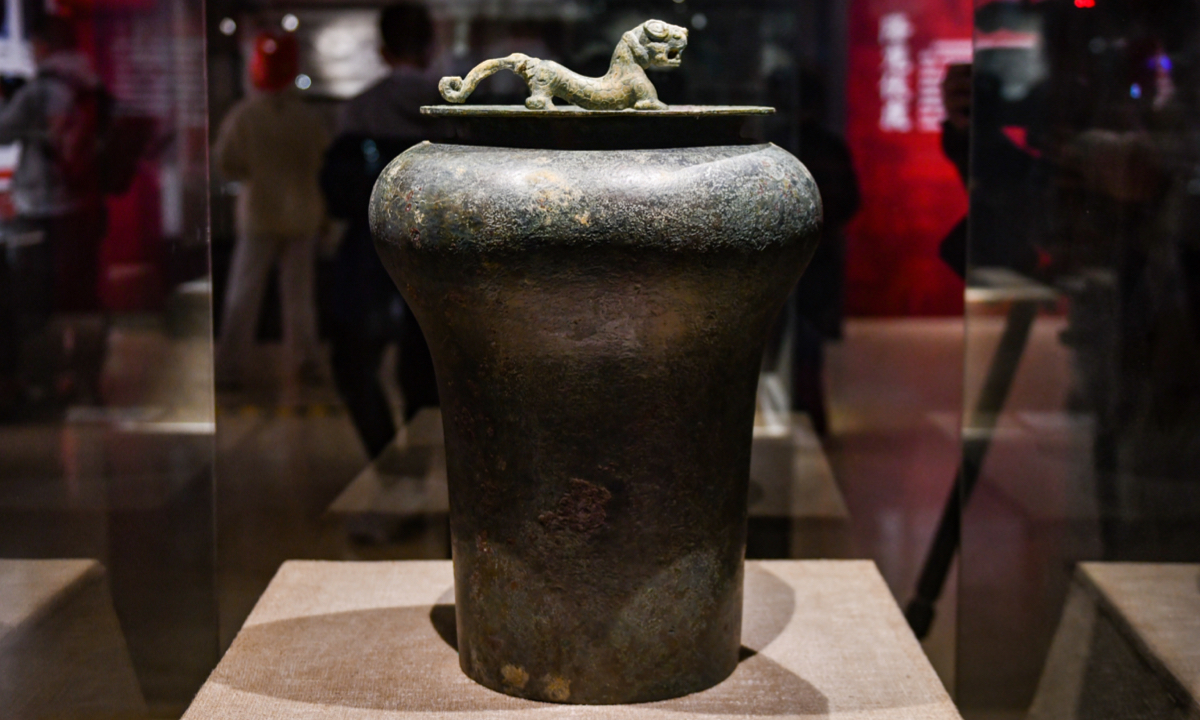
Chunyu Photo: IC
Currently, the number of Chunyu is estimated at 100 pieces, lx of which have tiger handles. The largest such chunyu was unearthed in Southwest Prc's Sichuan Province in October 2009, and is displayed in Shifang Museum, Sichuan Province.
The antiquity's body is inscribed with cloud patterns. Its overall height is 85 cm, the confront diameter is 41 cm, the shoulder diameter is 44 cm, and the bottom diameter is 28 cm. The tiger-shaped handle is 32 cm long, 8 cm wide. The tiger's mouth is broad open, and its fangs are raised, a media outlet based in Sichuan Province reported.
Such tiger handle decorations are unique, are of peachy significance to the study of rhythm and cultural nuance in aboriginal China, according to the official website of the museum.
The Chunyu was originally used for armed forces purposes. On the aboriginal battlefield, the chunyu and drum were used in tandem to signal advance or retreat. It later was used for sacrifices and feasts.
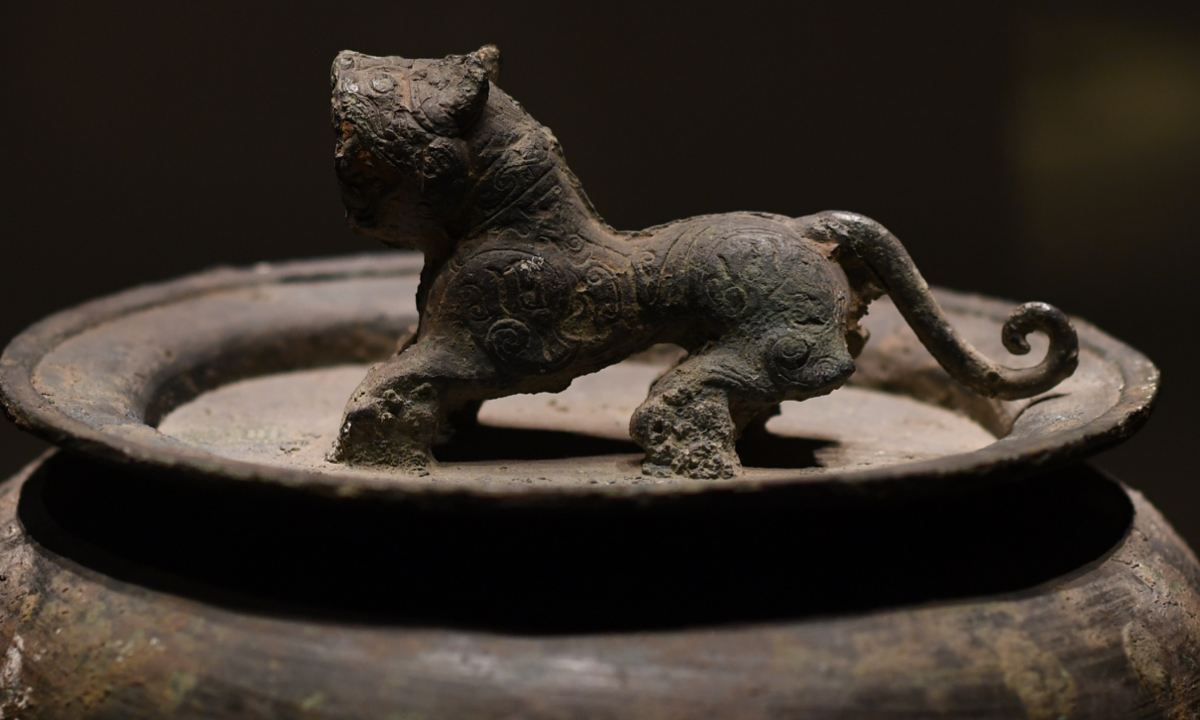
Chunyu Photo: IC
Experts said that the relic proved that people in Ba land, an ancient state in eastern Sichuan Province, treated the white tiger as a totem. According to historical records, a wise emperor in Ba state was transfigured into a white tiger after his death. Thus starting the worship of white tigers, and the huniuchunyu came into birth afterwards, according to the report of Cover News.
The most 'expensive' tiger
In 2010, a tiger painting by well-known 20th century Chinese artist Qi Baishi, was auctioned off at a staggering of $3.6 million at Sotheby's bound sale in China'southward Hong Kong, making this ink painting the most expensive among all Chinese tiger artworks. The high toll was because of its farthermost rarity and timing.
Born in 1864 in the Qing Dynasty (1644-1911), Qi'south works range from birds, to insects, flowers, and other nature elements. Yet he seldom composed works featuring such a huge creature at its cadre.
Amid only several tiger paintings made past Qi, this one was in fact a present to his good friend, Yang Hu, and was painted when Qi was in his 90s, according to Red china Central Television, while Qi's 2d most famous tiger piece of work has been nerveless in Beijing's Palace Museum since 1957.
What's more, the fact of how the form of the tiger was depicted is also rare in Red china's tiger paintings. Unlike virtually paintings which focus on the tigers' facade, Qi painted his tiger from the back, where ane can still feel the sturdiness and strength of its body through the rendering of the twisted but muscular figure without showing the animal'south face.
In addition to the rarity, the auction 12 years ago was also in the Twelvemonth of the Tiger, a symbol of forcefulness, exorcism, and bravery in Chinese traditional culture.
As the third animal in Chinese zodiac, this species has inspired artists in Red china for thousands of years. For example, Shi Ke, a well-known artist from the Northern Song Dynasty (960-1127), depicted a monk asleep on a tiger, to illustrate Buddhism. What's more, contemporary artist, Zhang Shanzi (1882-1940), reared 2 tiger cubs at his home in society to better study them.

Painting by Zhang Shanzi Photo: IC
The tiger is a symbol of good fortune in Chinese folk culture as the "hu" pronunciation of the Chinese give-and-take for tiger is like to some other word "fu," which means "blessing."
Equally an animal symbol with a positive meaning, the "tiger" chemical element has been used quite often in folk handicrafts designs. The near iconic 1 is the tiger-caput shoes, which is a type of traditionally handmade piece of footwear made particularly for children in the promise that the younger generation will grow up with abundant luck, strength, and courage.
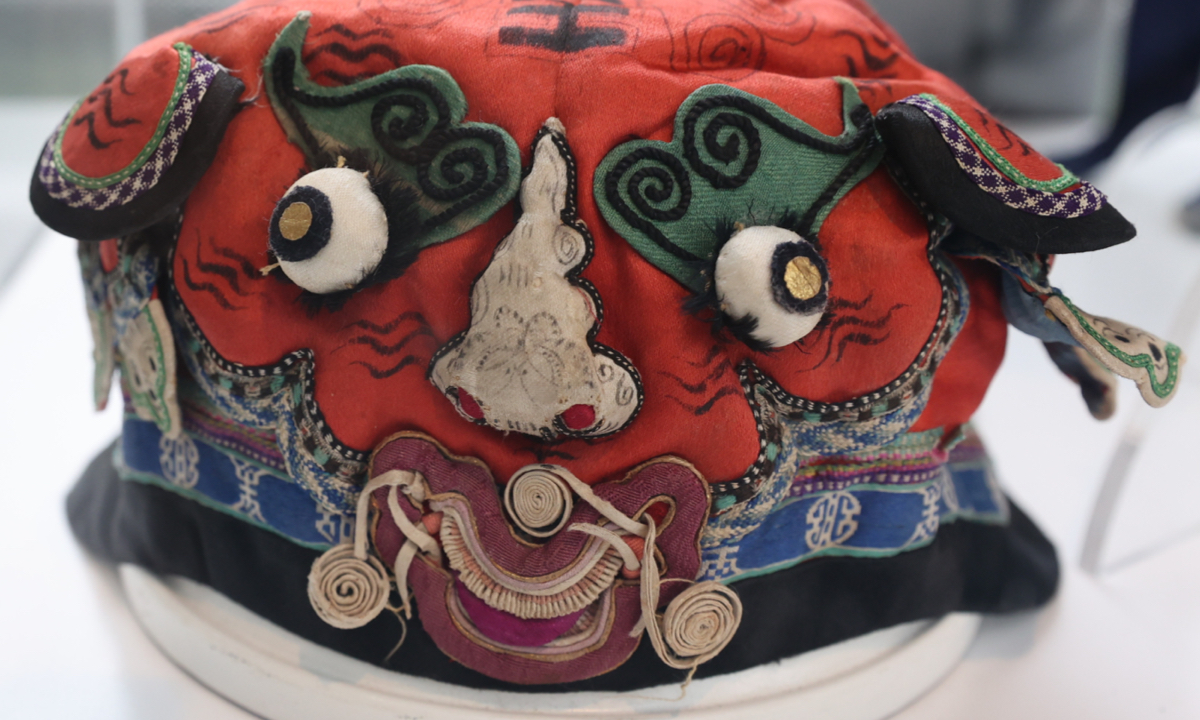
The tiger-caput hat Photo: IC
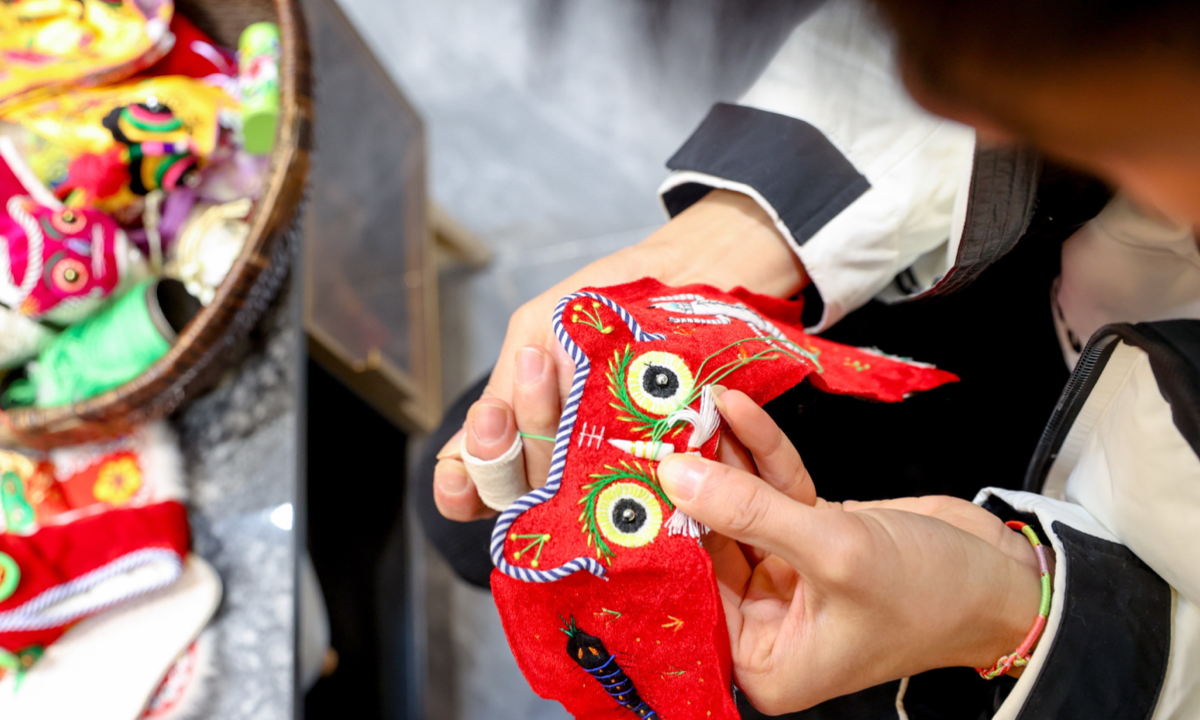
A woman makes a tiger-caput shoe. Photo: IC
The tiger-head shoe design adopts the full general course of the traditional Chinese material shoes, but its shoe caput is embroidered with a vivid tiger-head pattern. Most are made in red and xanthous, which also connotes auspiciousness. Although this shoe design originated in Due north China, information technology has become pop in other cities downwards south, for case, the silk-made tiger-head shoes are pop in Zhejiang and Jiangsu provinces due to their booming silk industries.
The manufacturing technique of such shoes has also been listed as part of China'south intangible cultural heritage. It shows the ingenuity of the traditional Chinese textile industry.
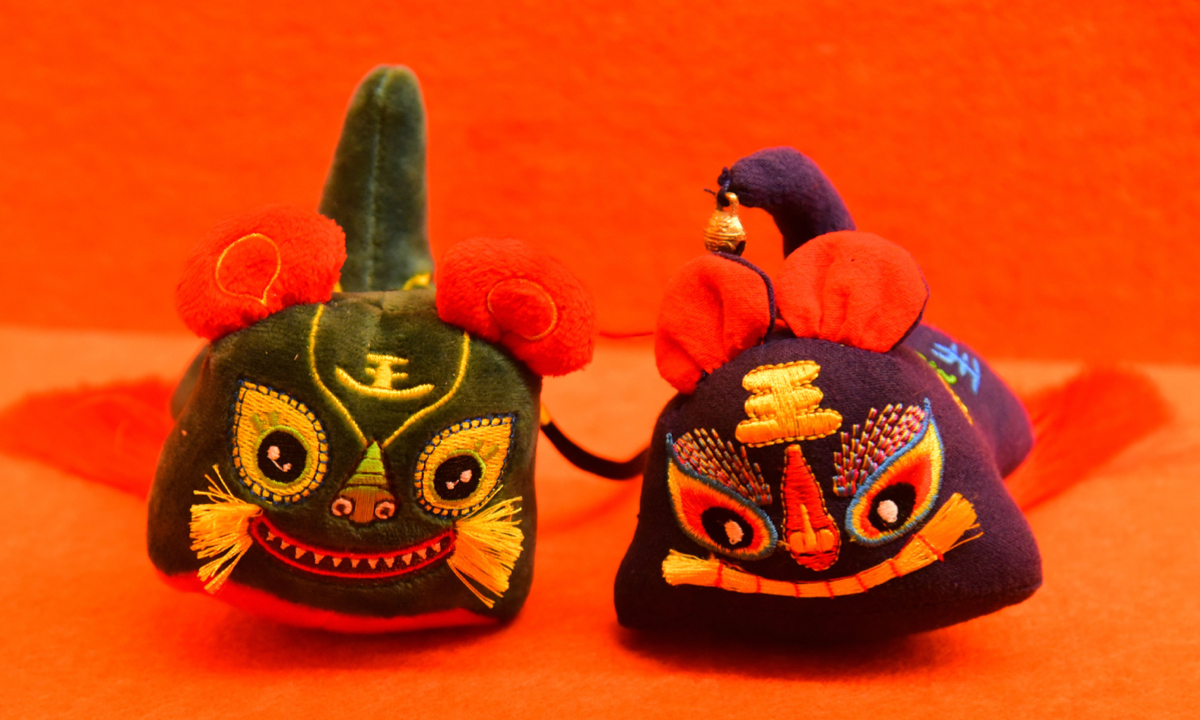
The tiger-head shoes Photo: IC
Aside from the tiger-head shoe, in that location are other tiger-shaped textile handicrafts such equally the tiger pillow, tiger hat, and the "material tiger," which is a traditional Chinese stuffed material toy, that's alsobeen listed in the National Intangible Cultural Heritage List in 2008. The "cloth tiger" and the tiger pillow in Cathay'due south folk tradition are sometimes stuffed with foodstuffs such as buckwheat husk. With the tiger design, such objects are believed to defend confronting evil and strengthen those who utilize them.
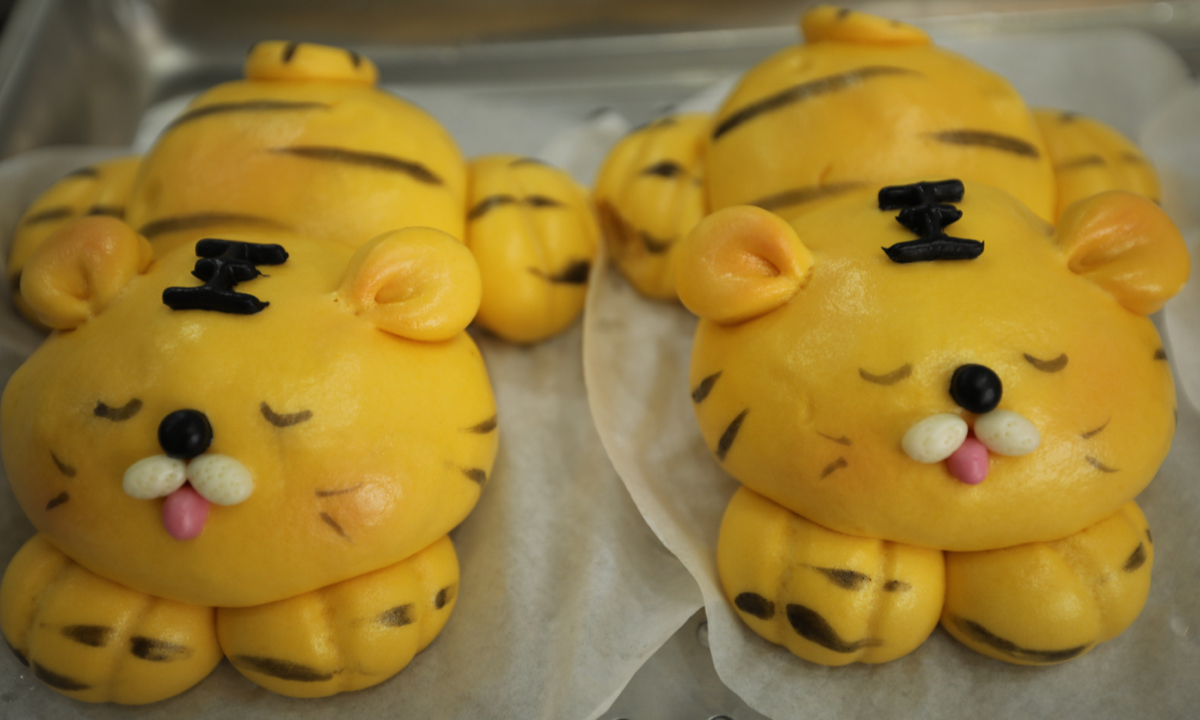
Tiger-shaped buns Photo: IC
Post-obit the "blessing tiger" folk tradition, a new born babe can too exist named "tiger boy" and "tiger girl." Such nicknames are believed to anoint the baby with good wellness and strength similar to that of a tiger. Elements of the tiger have also been used in Chinese pastries. Tiger-shaped buns are also a popular festival pastry mainly served as snacks and a desert during the New year feast. Experienced pastry chefs color plain dough with natural nutrient-safe dyes, and use them to make a bright 3D tiger figure that is cute and fun to play with like play dough. The detail pastry has been given the pregnant of "luck" and "fortune" to welcome guests.
levinewearecomell.blogspot.com
Source: https://www.globaltimes.cn/page/202201/1250273.shtml
0 Response to "when referring to a woman what is a "white tiger" in chinese"
Postar um comentário